Explore
Navigate
Home
 
Crete Guide
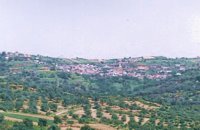
Agia Varvara town
Kenourgiou, Iraklion
Horafakia Car Rental, Akrotiri, Chania
GO TO: Horafakia Car Rental, Akrotiri
HomeMapThe area
Villages:

INTRODUCTION

This municipality is located in the centre of the Heraklion prefecture, and according to some, in the centre of Crete. It is surrounded by 8 different municipalities: to the north, Gorgolaini, Tetrachoriou and Temenos; to the east, those of Nikos Kazantzakis and Asteroussia; those of Kofinas and Gortys to the south and finally, to the west, the municipality of Rouva.
This municipality includes seven of the former communities: Aghia Varvara, Aghios Thomas, Moulia, Douli, Larani, Megali Vrisi and Prinias.
The municipality covers a surface of about 10.000 ha., from Malevizi to Monofatsi and the Kenourio province; it has over 5.000 inhabitants.
Geographically, the municipality lies at the foot of the Psiloritis mountain, at 530 m above sea level, and is one of the main thoroughfares leading up the mountain. It forms part of the mountainous landscape of the island.

The main sources of production are agriculture (olive trees and vineyards) and cattle raising (sheep). Other activities in the region are the following: olive oil production, cheese and dairy production, distillation of `tsikoudia` or `raki`, as well as commercial activities and public services.

Aghia Varvara is the chief town (seat) of the municipality with the same name. It has a population of more than 2.000 inhabitants and is 30 km away from the city of Heraklion, by the road that leads from Heraklion to Aghia Varvara, Moires and Phaistos, one of the main highways crossing the island from north to south.
Municipality Tel.:
+3 0894 23741 & 23742
Fax: +3 0894 23743

HISTORICAL BACKGROUND

The municipality has a rich archaeological and cultural past. The ancient city of Rizinia was located on a conspicuous height (686 m) near the settlement of Prinias. This height, also known as 'Patela of Prinias', is only accessible from the west.
The panoramic view extends as far as the island of Dia in the Cretan sea to the north, and to the Paximadi island to the south, in the Lybian sea.
It was the Italian School of Archaeology that excavated in 1906-1908 the ruins of ancient Rizinia, a city of importance from Post-Minoan to Hellenistic times (1600 to 67 BC). Its most notable monuments belong to the Classic period of the 7th and 6th centuries BC.
The location was highly strategic: Rizinia lay half way between Knossos and Gortys, the two largest cities in Crete, one to the north, the other to the south, and from the Patela height, the town commanded a large area.
The ruins of an imposing Hellenistic castle have been found (330-70BC), built from stones cut out of more ancient buildings and tombs. Some of the stones bear inscriptions and are incised with different shapes: on one there is a female figure wearing a long chiton, holding a spindle and with a half-filled distaff on the lower part. On another, a warrior, with helmet, shield and lance. These stones come from a burial site belonging to the first Hellenistic period. A great number of sherds, votive clay objects and figurines have been found among the ruins of ancient Rizinia, as well as the remnants of two temples.
One of them, to the east of the site, was dedicated to the goddess Rhea and from the charred bones that were excavated, it seems obvious that animal sacrifices were held there. Many sculptures in porous stone were found in and around the temple, and are now in the Archaeological Museum of Heraklion.
Close by, the cemetery was excavated, bringing to light interesting objects found in the tombs.
According to many archaeologists, the ancient town of Panona was located not far off, where the village of Aghios Thomas now stands. Around the village there are many caves, cisterns and a beautiful wine-press, all cut out of the rock.

THE SIGHTS

A visit to the municipality of Aghia Varvara is indispensable for those who want to get to know Crete, especially the hinterland. There are many sites of interest for the visitor.

ARCHAEOLOGICAL SITES.

Ancient Rizinia and the cemetery at Prinias. Tombs carved out of the rock and the wine-press at Aghios Thomas.

NATURAL SITES

The valley of Prinias, the Perdikokorifi at Prinias, the Acropolis at Rizinia, the unique 'forest' of oleanders in Crete, and the drive from Moni Kardiotissa to Aghios Antonios in the Aghios Thomas area.
The height of Taga with the Aeolian park, between Aghia Varvara and Moulia, and the hill at Anemomilos.

CHURCHES AND CHAPELS

The churches of Aghios Ioasaf, Spiliotissa, Kardiotissa, Aghios Antonios in Aghios Thomas.
Byzantine churches of Profitis Ilias, Aghios Giorgos in Aghia Varvara and Aghios Ioannis in Megali Vrisi, and the old monastery of Aghia Pelagia.
The church of Zoodochos Pigi in Ano Moulia, those of Armiri and Aghia Anna in Megali Vrisi, and the church of Aghios Nikolaos in Douli. The municipality of Aghia Varvara has a unique richness in flora and fauna, of great interest and beauty.

COMMUNICATIONS

The municipality has good paved roads linking all the villages to each other and making access easy to all the sites.
There is a bus service from Heraklion to all the villages in the municipality, leaving every half hour from the square Machis Kritis at the Chanioporta in Heraklion.
Agios Thomas village
Agios%20Thomas%20village
 
Kenourgiou, Iraklion

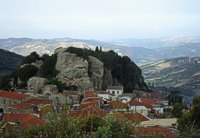
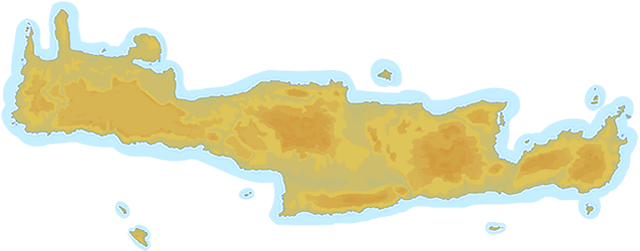
Agios Thomás (GR: Αγιος Θωμάς) lies at 530 m above sea level. It is 30 km away from Heraklion and has a panoramic view over the whole area to the SE of Aghia Varvara.
Agios Thomas is a very old village and the first reference we have of it, is in a document of 1371, where it is quoted as a feudal property of Petrus de Medio, and again in a document dated 1380. Later, it figures in all the Venetian censi of the 16th and 17th centuries. In 1881, and in 1900, it figures as part of the Megali Vrisi municipality, with 344 inhabitants. From 1920, it figures in all the censi as a community with a continuously growing number of inhabitants. Nowadays there are over 800 inhabitants.
Agios Thomas owes its name to the tripartite domed church, which still preserves part of its original wall paintings. The north nave is dedicated to Saint Nicholas, the south one to Saint Charalambos and the centre one to the patron saint, Saint Thomas; the church is located in the centre of the village.
Of the 40 churches that are said to be in the village, the visitor should make a point of visiting the following: Aghia Paraskevi, with remains of wall paintings, Michail Archangelos, with wall paintings of the 12th century, Aghios Panteleimonas, Aghios Ioannis, and the chapel of Panagia Kardiotissa at the lovely site of Mouzouras.
There are a great many caves and cisterns cut out of the rock in the area; the caves were used as graves.The village of Aghios Thomas boasts of two great personalities born there: Kirikas Chairetis Kalamaras and the empirical doctor and fighter Logios, born in 1771. He fought the Turks from 1800 to 1815. He is buried opposite the ancient town of Phaistos.
The small settlement of Ardachtia or Argathia, lies 500 m from Agios Thomas. The name Argathia figures in all the Venetian censi of the 16th and 17th centuries. As of 1881, through a mistake in the spelling, it is recorded as Ardachtia. On the verge of collapse, the village was abandoned and has been rebuilt as a neighbourhood of Aghios Thomas, at Plaka.

Panoramio™ Photos   [Area]

Megali Vrissi
Megali%20Vrissi
 
Kenouriou, Iraklion

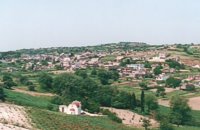
Megali Vrissi (GR: Μεγάλη Βρύση) lies 32km south of Heraklion, at 620 m above sea level.
In the Barozzi document of 1577, it is mentioned as forming part of the province of Monofatsi and, in the Archives of Megalo Kastro (Heraklion), it is quoted in 1583 as having 71 inhabitants; there is also a reference to the village in the Basilicata document of 1630. The Turkish census records it with 47 families in 1671, and in the Egyptian one in 1834, it figures with 27 families. In the censi of 1881 and 1900 it is mentioned as a municipality in its own right with, respectively, 240 inhabitants and 307 inhabitants.
As of 1928, it becomes a commune and today it counts over 900 inhabitants. Saint Constantine is the patron saint of the village.
The churches of Aghia Anna and of the Panagia Almiri are worth visiting.
The Aeolian Park, one of the islands pioneering projects, has been installed in Megali Vrisi and produces electricity of 5MW.

Panoramio™ Photos   [Area]

Prinias village
Prinias%20village
 
Kenourgiou, Iraklion

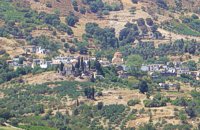
Priniás (GR: Πρινιάς) is a small village located 35km southwest of Iraklion town and 4km from Agia Varvara, at a height of 610 m above sea level. The village of Prinias lies on the border of three regions: Malevizi, Kenouriou and Monofatsi, and is recorded as forming part of all three regions in the censi.
Panoramio™ Photos   [Area]

Douli village
Douli%20village
 
Kenouriou, Iraklion

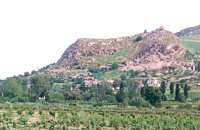
Doúli (GR: Δούλι) is a village in Kenouriou county, located 38 km from Iraklion at an altitude of 440 m above sea level.
The earliest reference to it, is to be found in the Duke's Archives of 1372, where it is mentioned as the feudal property of Nic. Venerio. The name figures in all the Venetian censi of the 16th and 17th centuries, as well as in the Turkish (1671) and Egyptian (1834) censi. In 1881, Douli forms part of the municipality of Megali Vrisi with about 170 inhabitants, and again in 1900 with only 21 inhabitants.
As of 1920, Douli is a commune in its own right, and today Douli has about 240 residents. The patron saint of the village is Aghios Panteleimonas and the feast of the Saint is celebrated on July 27th.A visit to the old church of Aghios Nikolaos is also a must. For those interested in paleontology, there are fossils to be found at the location 'Pirgos'.
Panoramio™ Photos   [Area]

Moulia village
Moulia%20village
 
Kenourgiou, Iraklion

Moúlia (GR: Μούλια) is a village in Kenouriou county, located three and a half kilometers away from Agia Varvara town and 32 km from Iraklion at an altitude of 640 m above sea level. Moulia is an old village as we come across a reference to it in a document dated in 1248, where the settlement is recorded as belonging to the archbishopric of Crete. Another reference is found in a legal agreement established in 1411. The name figures in all the Venetian censi of the 16th and 17th centuries, as well as in the Turkish and Egyptian censi. In 1881, it forms part of the municipality of Zaros with about 180 inhabitants, and again in 1900. As of 1920 it is a commune in its own right, and today with the lower village of Kato Moulia it counts over 550 inhabitants. The main church of the village, with wall paintings, is that of the patron saints, Saints Peter and Paul, and there is a village feast on the 29th June, in their honour. The lovely chapel of Zoodochos Pigis is also well worth a visit.

Panoramio™ Photos   [Area]


Horafakia Car Rental, Akrotiri, Chania
GO TO: Horafakia Car Rental, Akrotiri


Navigate | Explore
Contact Us
Your gateway to Crete
©interkriti.org 1996-2013

Top